patrick.net
An Antidote to Corporate Media
1,363,742 comments by 15,736 users - HANrongli online now
And Now For Something Completely Different
2006 May 28, 4:17pm 20,898 views 108 comments
by astrid follow (0)
« First « Previous Comments 104 - 108 of 108 Search these comments
 Randy H
2006 May 30, 11:14am
Randy H
2006 May 30, 11:14am
There is a nice graph of monopolistic competition here.
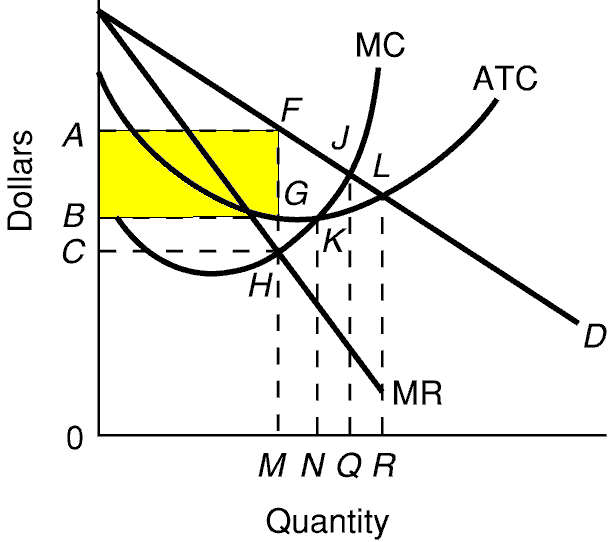
The important thing to note is that in monopolistic competition (meaning simply that new suppliers cannot readily enter the market), the supply curve becomes either non-existent or de-emphasized. In rental RE the is definitely a supply curve, but it is not nearly as relevant as the demand curve. Part of this is political (NIMBY, regulatory barriers) and part of it is because of the nature of real estate (takes time to develop new units, cyclical, large capital requirements).
Randy H
2006 May 30, 11:16am
In that graph above, the yellow upper rectangle is what the supplier "takes" away from the consumer. The lower unshaded rectangle is the "welfare loss", or the part that neither supplier nor consumer gets as utility value because the market is not perfectly efficient.
Randy H-
I hate to say it, but I don't agree with anything you have said. I suspect I am missing something, thoguh, as you seem well informed on this issue. Could you please elaborate? Maybe then I will understand.
Rental RE is a textbook example of anything but a perfectly competitive market.
Market power
Huh? No landlord has market power. In antitrust law, the FTC has a crude rule of thumb that a competitor must control 60% of the market, and there must be substantial barriers to entry, in order to have market power. What landlord controls 60% of the market? In most major cities I bet you'd have trouble finding someone who controls 5%. I don't see anyone with market power in the residential rental market; on the contrary, market power seems awfully diffuse given that rental property in every major city I am familiar with is owned by thousands upon thousands of landlords.
pricing collusion
No way. There is no way that the landlords are conspiring to set prices. Most don't even know each other, much less communicate and agree upon a common pricing scheme. And even if they did, there aren't any mechanisms for punishing defectors. If landlord A and B agree to fix prices, and landlord B then decides to screw his A by undercutting him in violation of their agreement, there is absolutely nothing that A can do about it. The only companies that can actually enforce price-fixing schemes are ones engaged in regulated industries, government contracting, etc.. These guys can make one another's lives miserable; if you undercut me on this bid, I'll undercut you on the next one, etc. But landlords? There is nothing they can do.
pricing cooperation (the legal game theory kind)
This might happens in large corporate apartment buildings, although I tend to doubt it, anytime the vacancy rates creep up over 10% I would think that cooperation would go out the window. But there is no way that someone who owns a single rental condo is doing the market surveys necessary to engage in pricing cooperation. Your typical small-time landlord just glances at the newspaper to see what everyone else is charging and sets his rental rates accordingly. There is no way that these small time landlords engage in the sophisitcated signaling, etc., necessary to engage in price collusion. And they are a huge percentage of the market!
asymmetric information
How so? Everyone can check craigslist, the newspaper, etc. There are apartment brokers, classified ads, bulletin boards -- there are plenty of places for renters to engage in price comparisons.
lack of substitutes
Yes and no. While the supply of rental housing is relatively static, at least during the month or so that potential renter X is looking for a new place, there is still some substitutiability. A renter can substitute one neighborhood for another; a long commute for a short one; one roomate for another; a solitary apartment for one shared with roomates; etc.
price stickiness
Not necessarily. I guarantee you that rental rates will go down -- fast -- in Phoenix and places like it in the near future. Also, the income of renters is sticky, too.
shifting elasticities
Like what? Incomes of renters aren't rising. The population isn't growing nearly as fast as the supply of rental units in most cities. I just don't see this.
macroeconomic forces pressing down on the market from above.
Which forces? I honestly don't know what you mean here, if you can identify the forces it might help me understand.
I have the perfect cure for the bubble blues: Quasar and Zenith TVs.
Why?
I'm not sure. But I think it has something to do with 1970s Bundt cakes
& Tupperware parties.
I think I'm flipping out...losing it...
 bikes2work
2006 May 31, 5:53am
bikes2work
2006 May 31, 5:53am
My main point is that rental RE is NOT a perfectly competitive market.
Especially when landlords can be picky about the renters. I used to rent a beautiful Victorian flat in north Oakland. The place was a total bargain, but the landlady was super picky about tenants. You never see an advertisement where they tell you the minimum credit score required. It only ever says credit check required. It isn't first come, first rented.
« First « Previous Comments 104 - 108 of 108 Search these comments
And now for something completely different. What? I don't know. Threads always end up going where the posters want them to go.
However, here's something to start off the discussion.
What is the maximum amount you're willing to pay for rent/PITI? This means that if rent/PITI goes above this amount, you would consider moving out/moving home/roommates to decrease your costs.
(warning: this threadmaster may modify or erase sexually explicit and trollish comments)